A living history. These are the questions still open, each with the next document named. Where the story behind one is told in full earlier on the page, this points there rather than telling it twice.
1 · Who was Herszko's father? Leading candidate, 2026
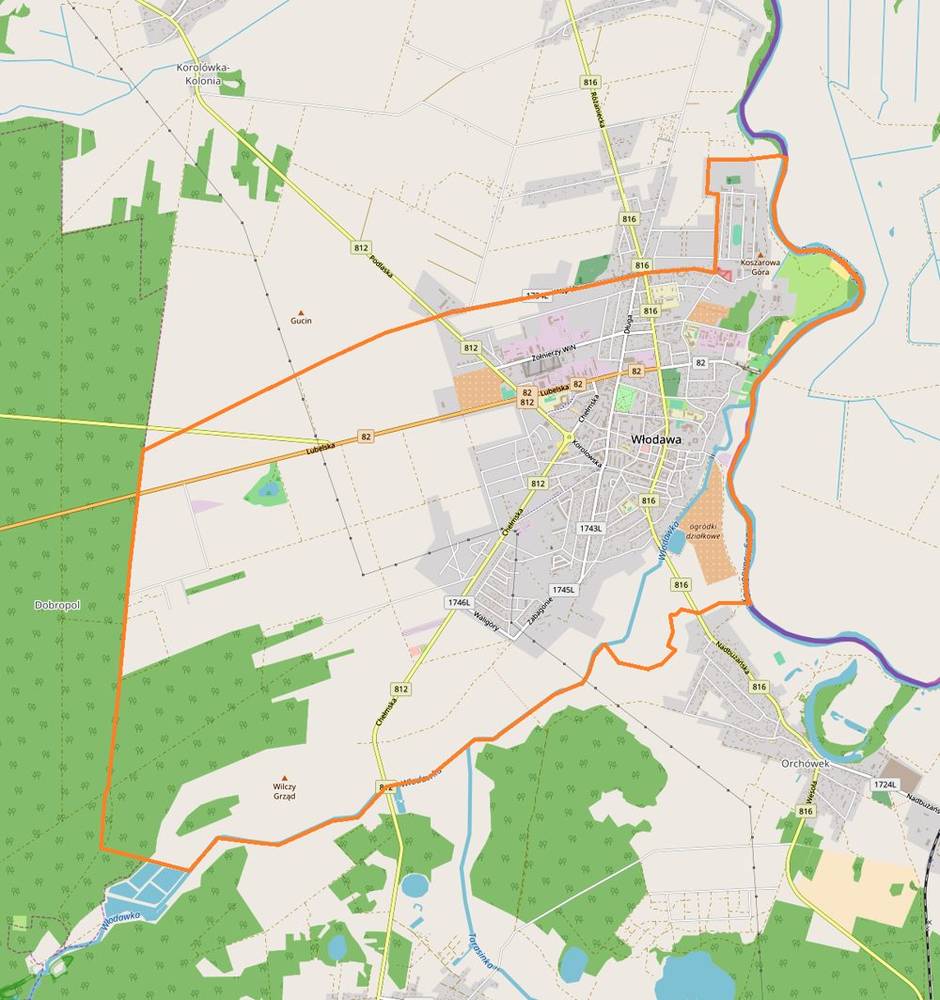
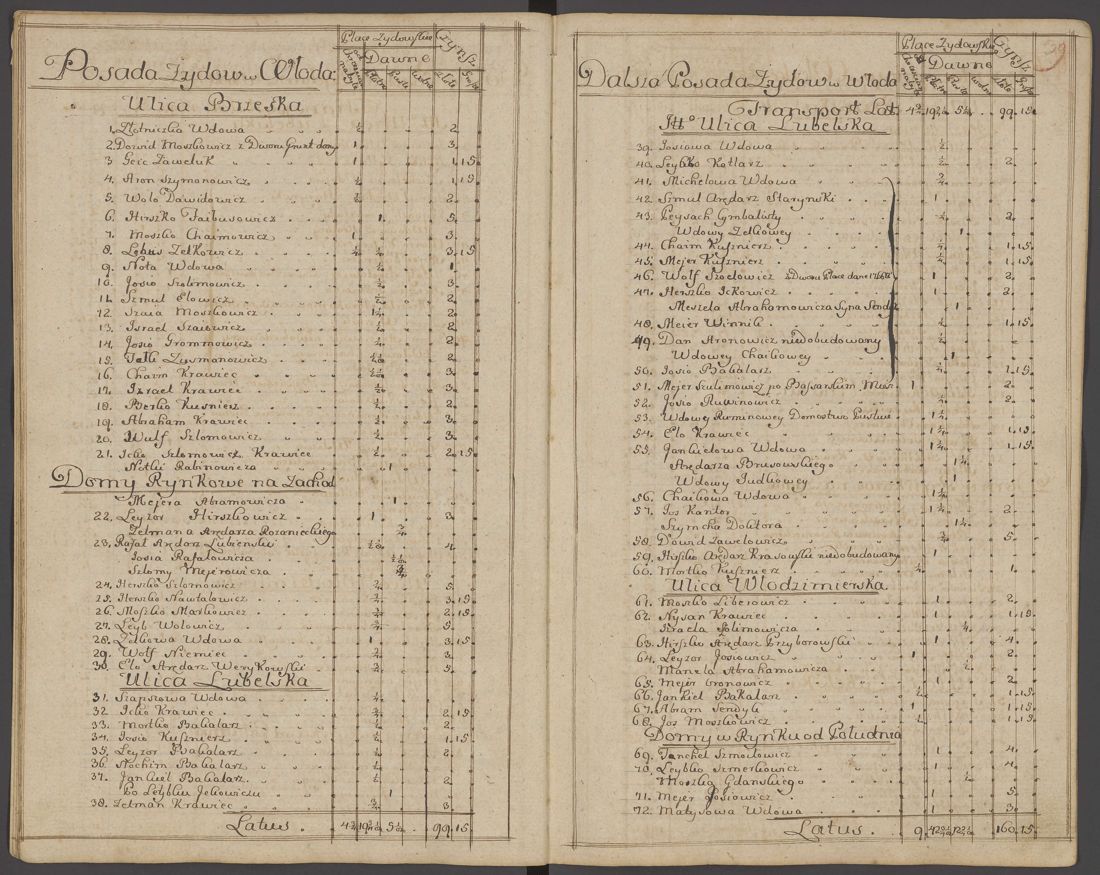
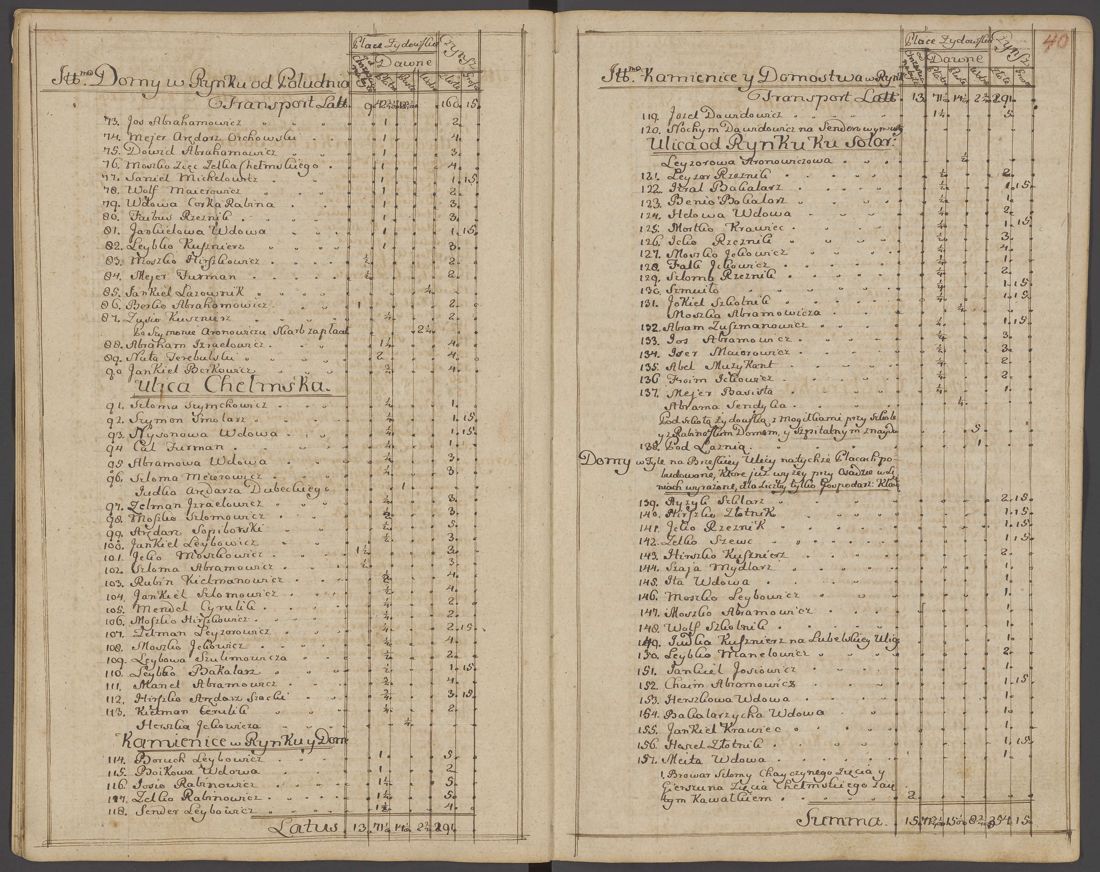
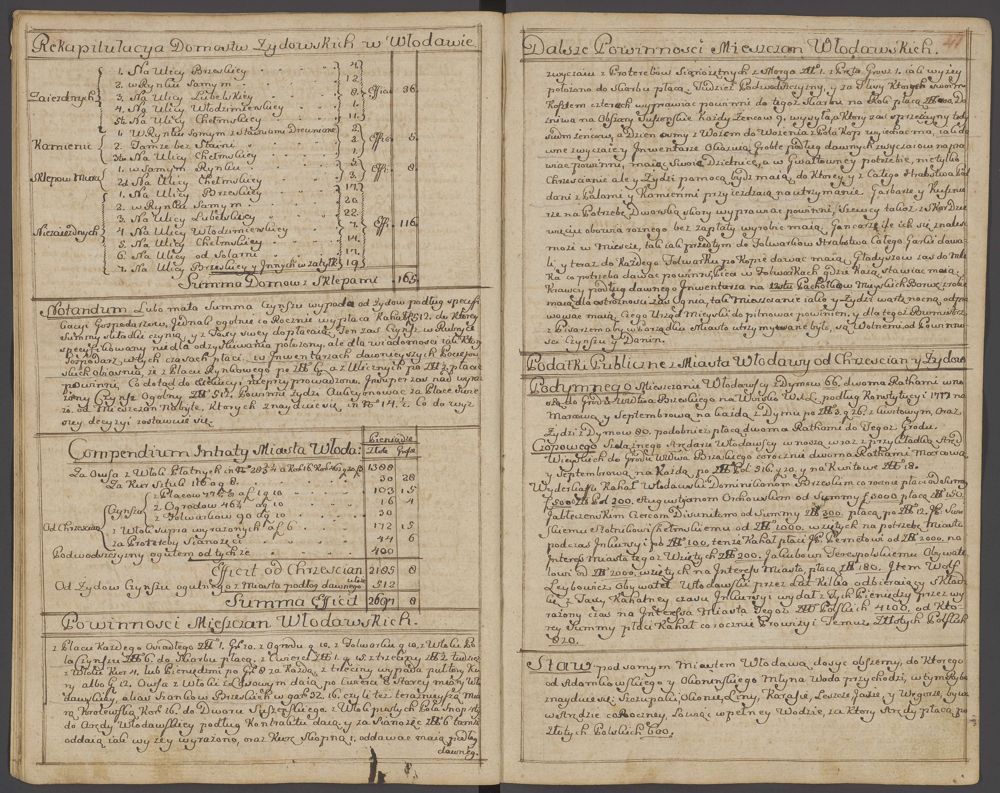
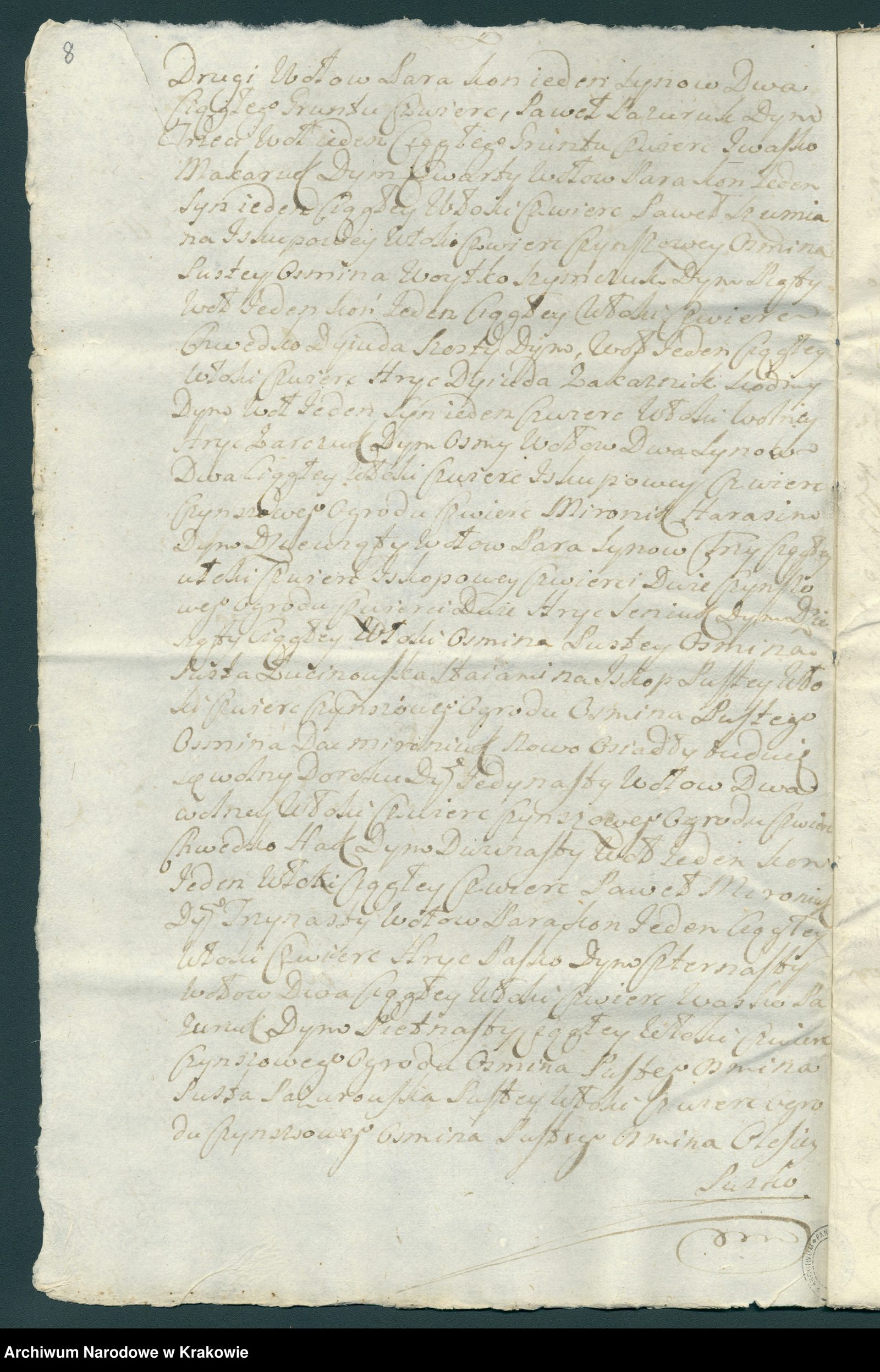
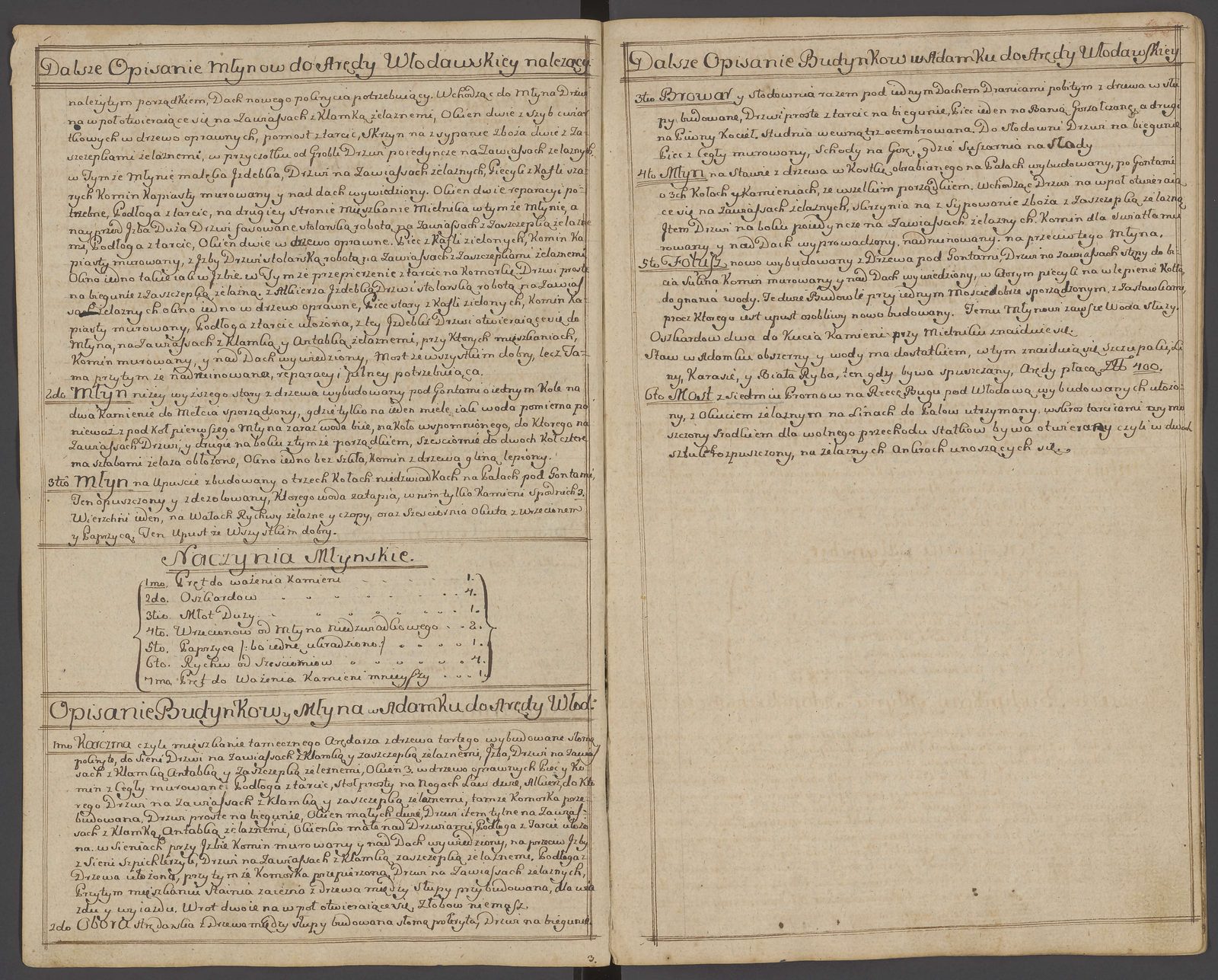
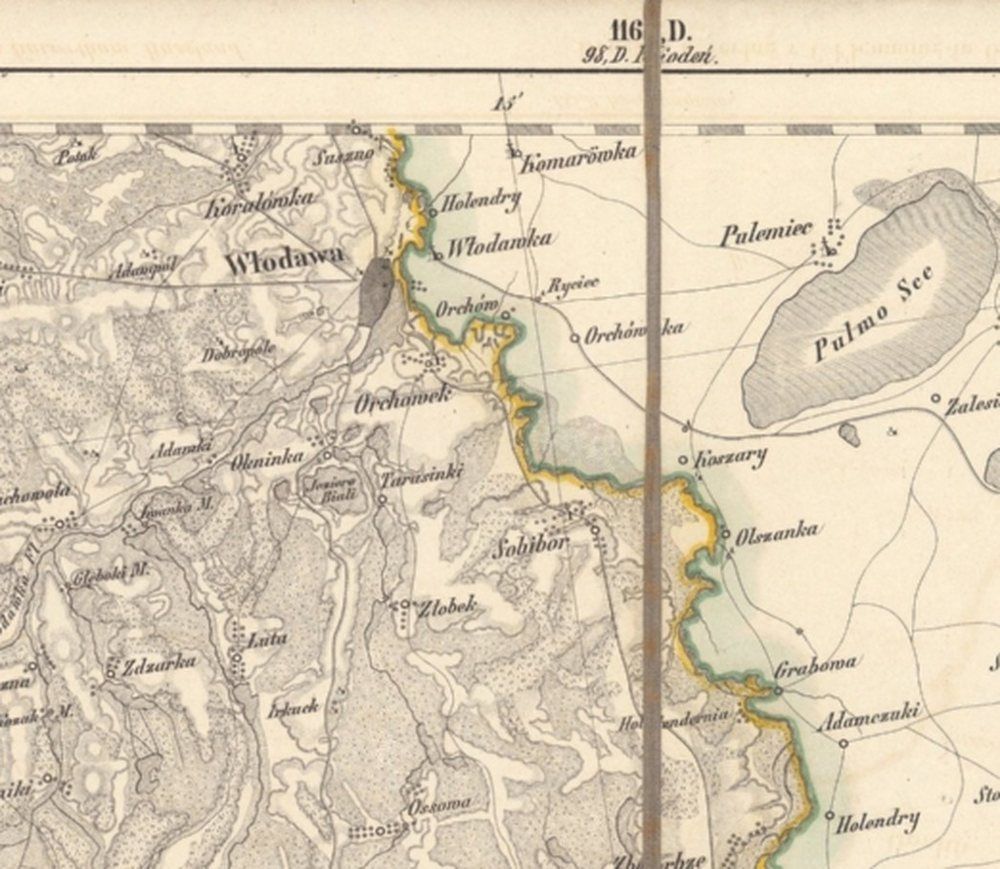
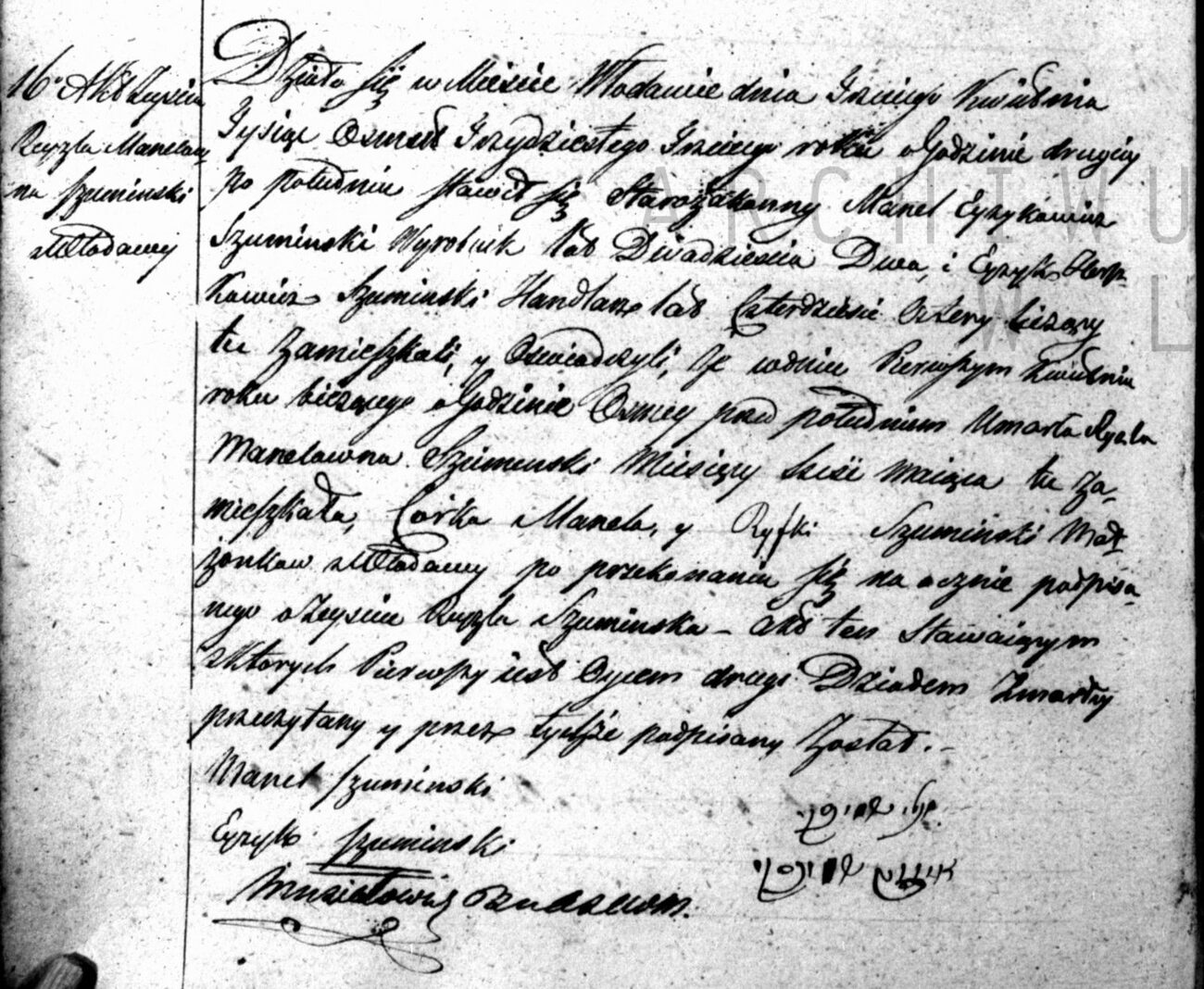
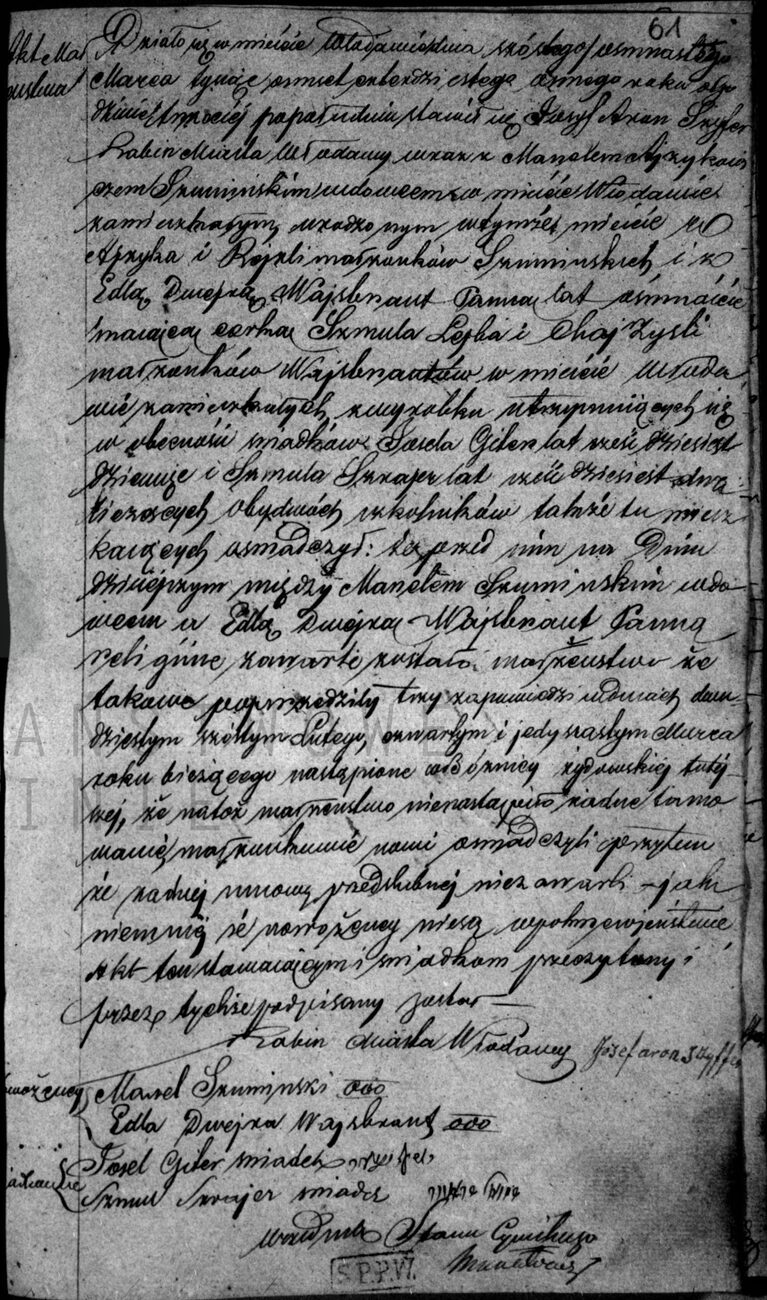
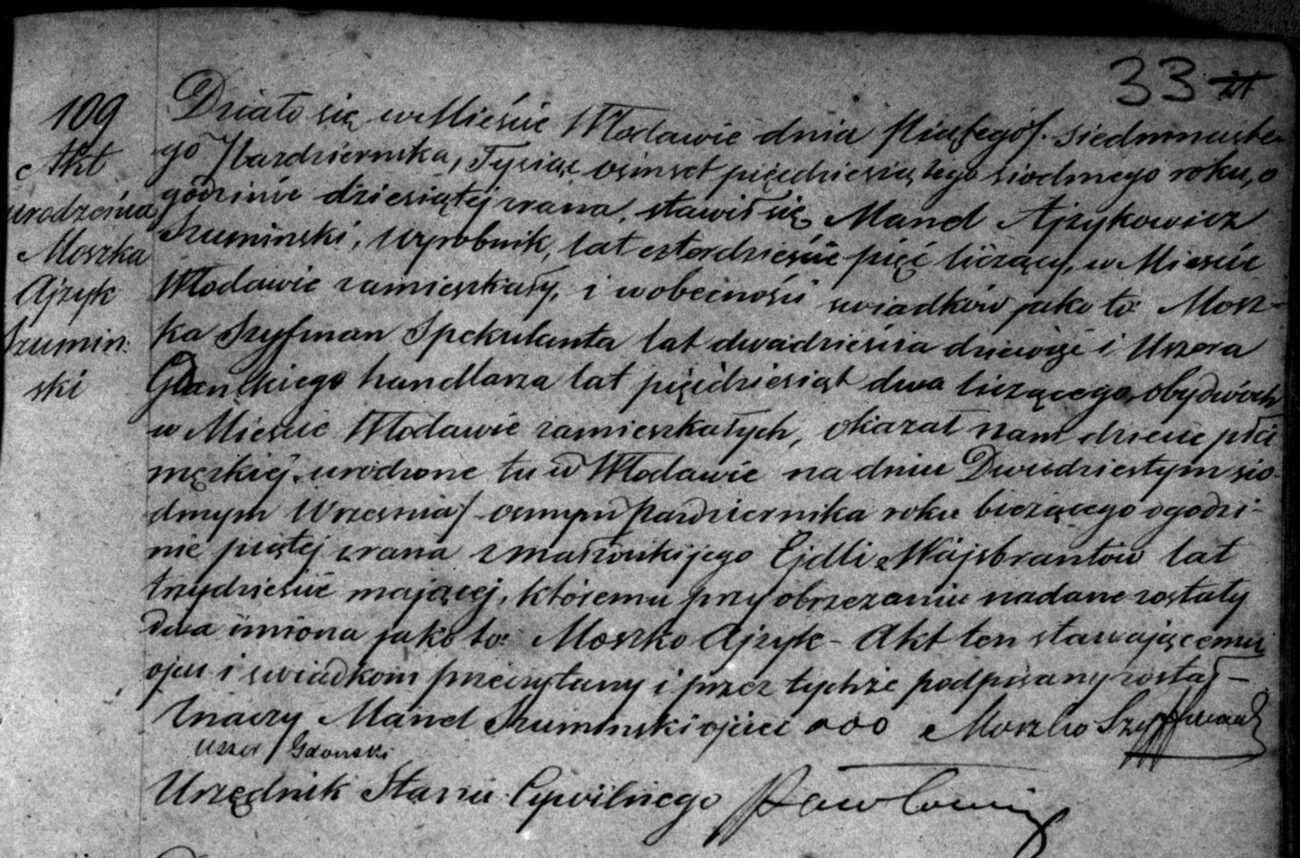
The deepest documented man is still Herszko. The death registers that would name his father, 1837–83, are missing from the copy series held in Lublin — which is not quite the same as lost. Whether a second, parallel set survives, either as dublety or with the registrar in Włodawa, has never been asked. Włodawa was not in Crown Poland's Chełm Land — it belonged to the Grand Duchy of Lithuania, its kahał under Brześć — so the ladder back runs through the 1764/65 Lithuanian poll-tax and the Zamoyski/Czartoryski estate inventories, not Crown records. The 1773 Włodawa census (see Chapter II½) put four men named Herszko on the page for the first time — none yet linkable, and a targeted search for their patronymics recurring in later registers came back empty. A 1792 AGAD estate inventory adds three more Hersz-rooted names, and one has pulled ahead: Zelman Herszkowicz — explicitly recorded as a named son of a Herszko, and a documented property owner three times over: a masonry corner inn at the market square, his single most valuable holding; an adjoining plot with the foundations already started; and a house he'd sold to the Crown treasury before 1792, later converted into the town's customs house. His own household entry — the line that would carry an occupation and test whether he's a previously unknown brother of Ajzyk — still hasn't turned up, even after the named-household register was read essentially in full, both by eye and by handwriting-recognition software. What that full read did surface: Herszko and Zelman were both common given names in this community — six different men carried "Hersko" or "Herszko" as a first name or patronymic across the register's pages — which is exactly why the name alone keeps producing near-misses instead of a match. The Szuminka folwark inventory arrived and was read in full (46 scans, July 2026): it turned out to hold no list of arendarze or Jewish residents after all, but it did settle something else — Szuminka was a real, populated hamlet with its own manor farm and a named census of about twenty tenant families, none of them surnamed Szumiński or Herszko. What it also surfaced, unexpectedly: the village's liquor concession was administered through an unnamed "Ardarz Szuszeński" — the leaseholder of the neighboring Susno estate — and two of the four 1773-census Herszko candidates already held that exact kind of leaseholder post elsewhere in this same estate. If that unnamed office-holder can be identified and turns out to be Hirszko-rooted, it would be the first document to tie a Herszko-named man to a role over Szuminka itself. Three parallel tracks were live in July 2026: the paleographer commission (Piotr, PolishOrigins); a targeted query for the Susno leaseholder's name elsewhere in the same fond; and the Grand-Duchy ladder — the 1764/65 Lithuanian poll-tax, Brześć kahał district.
September 2026 — two leads on that ladder were withdrawn before they were ever published here, and a third turned out to be already in print. A citation this project had been carrying to AGAD, Archiwum Radziwiłłów dział VIII as a place holding the Council of Lithuanian Jews’ dealings with the Brześć kahał does not survive contact with AGAD’s own finding aid, which describes dział VIII as Akta dotyczące duchowieństwa — records concerning the clergy. And a work cited repeatedly in the working notes as Anatol Leszczyński’s Materiały do dziejów Żydów appears in no library catalogue and in no item of his own surviving papers at the Jewish Historical Institute. It is not a book. What replaced them is better and needs no archive at all: the Council kept a central register, and Simon Dubnow published it in full in 1925 from the Grodno manuscript — a printed edition that apportions the poll tax by district and carries Brześć z okręgiem as a line of its own. It will not name a household. It will say what the Brześć kahał was assessed, and therefore roughly how many Jewish families the Council believed it had — the frame every search on this frontier has so far been missing.
September 2026 — one track closed, and somebody else turned out to have read our document. The Lithuanian State Historical Archives in Vilnius confirmed it holds the right collection, fond 11, and then declined to search it: there is no index, the search would have to be done page by page, and in their words, "we are unable to conduct such a search." That is a refusal, not a price — the paid Vilnius track is closed, and what remains is a reading room and somebody willing to sit in it. Whether the 1765 census even names Włodawa, rather than folding it under Brześć, is still unknown; the free step is narrowing the target before anyone pays to turn pages.
Against that, a genuine gain, and from an unexpected direction. The regional encyclopedia of the Centrum Badań nad Historią Regionalną i Lokalną at UMCS in Lublin publishes its own reading of the Jewish householders in this same unit, citing [APL, AZWłod., sygn. 3, k. 38v–40v] — folios inside the ones held here. Two of the names match this page's own transcription exactly: Hirszko Faibusowicz and Leyzor Hirszkowicz. A university's reading and an amateur's reading of the same eighteenth-century hand, arrived at independently, agreeing. That is the kind of corroboration this project was preparing to commission, and it was sitting in a public encyclopedia.
It also carried a correction in waiting, and the check has now been run. Where this page reads Herszko Nawtalowicz, UMCS reads Herszko Naftalowicz — son of Naftali, a real name, where Nawtalowicz corresponds to none. The obvious conclusion was that the university had it right and that a ft had been misread as wt. The scan says otherwise. This scribe’s f is unmistakable: in Wulf at line 20 and Wolf at line 46 it drops a long loop well below the baseline. The disputed letter at line 25 has no descender at all, and its shape matches the w in that same name’s own -owicz ending, four letters later. Two independent machine passes over the page — an in-house vision read and a Transkribus handwriting model — both returned Nawtalowicz as well. So the manuscript reads what this page has always said it reads, and UMCS’s Naftalowicz is an editor’s emendation toward the name that must lie behind it. The two are almost certainly pointing at one man, whose father was called Naftali. The transcription stands; the note here that said the university was probably right does not. And one finding that runs the wrong way, recorded because it does: this 1773 list holds a Zelman Izraelowicz and a Zelman Leyzorowicz, neither of them the Zelman Herszkowicz of 1792. Three Zelmans, three different fathers, two documents — which weakens the leading candidate rather than strengthening him.
2 · The fourth son Narrowed
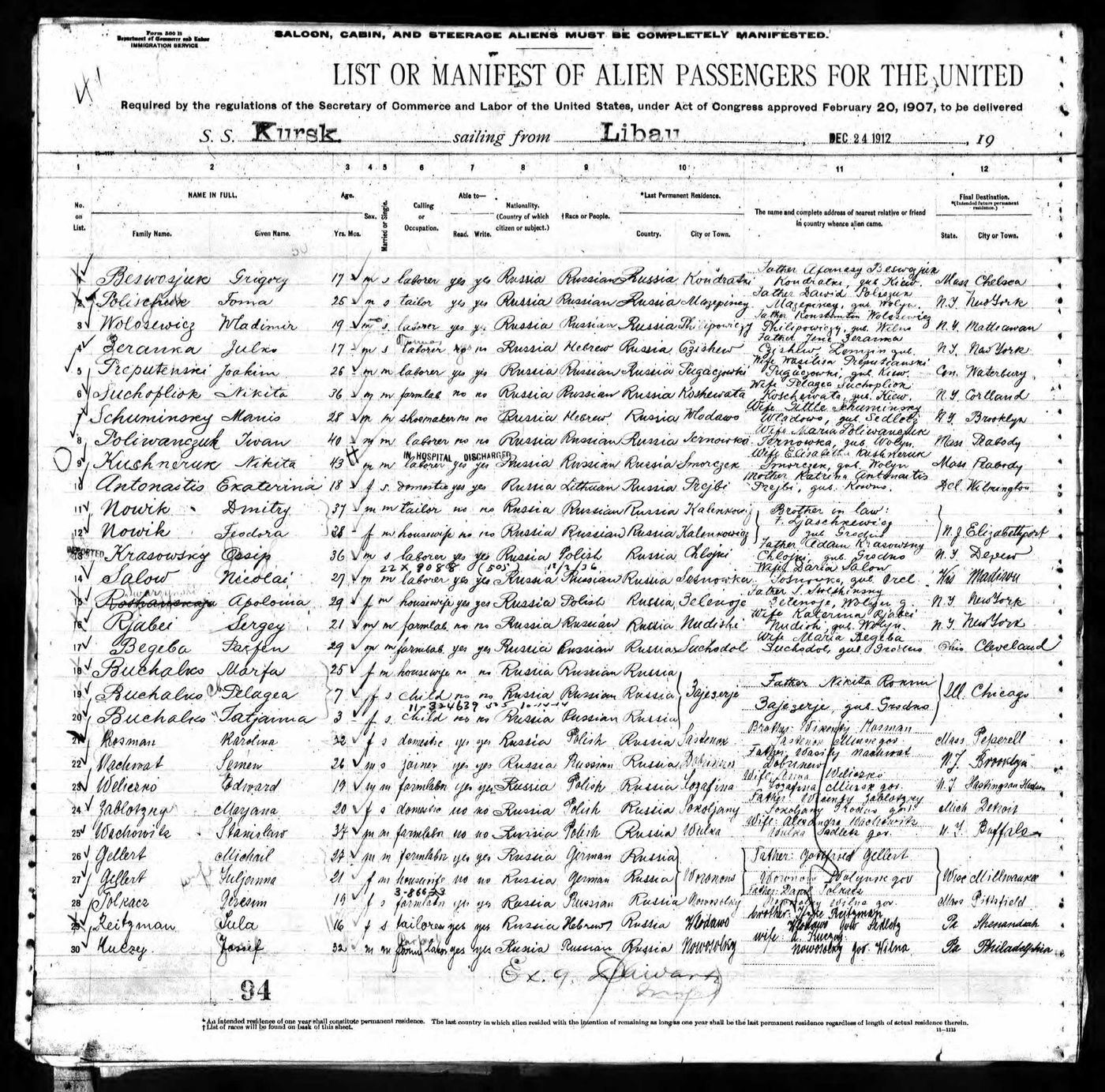
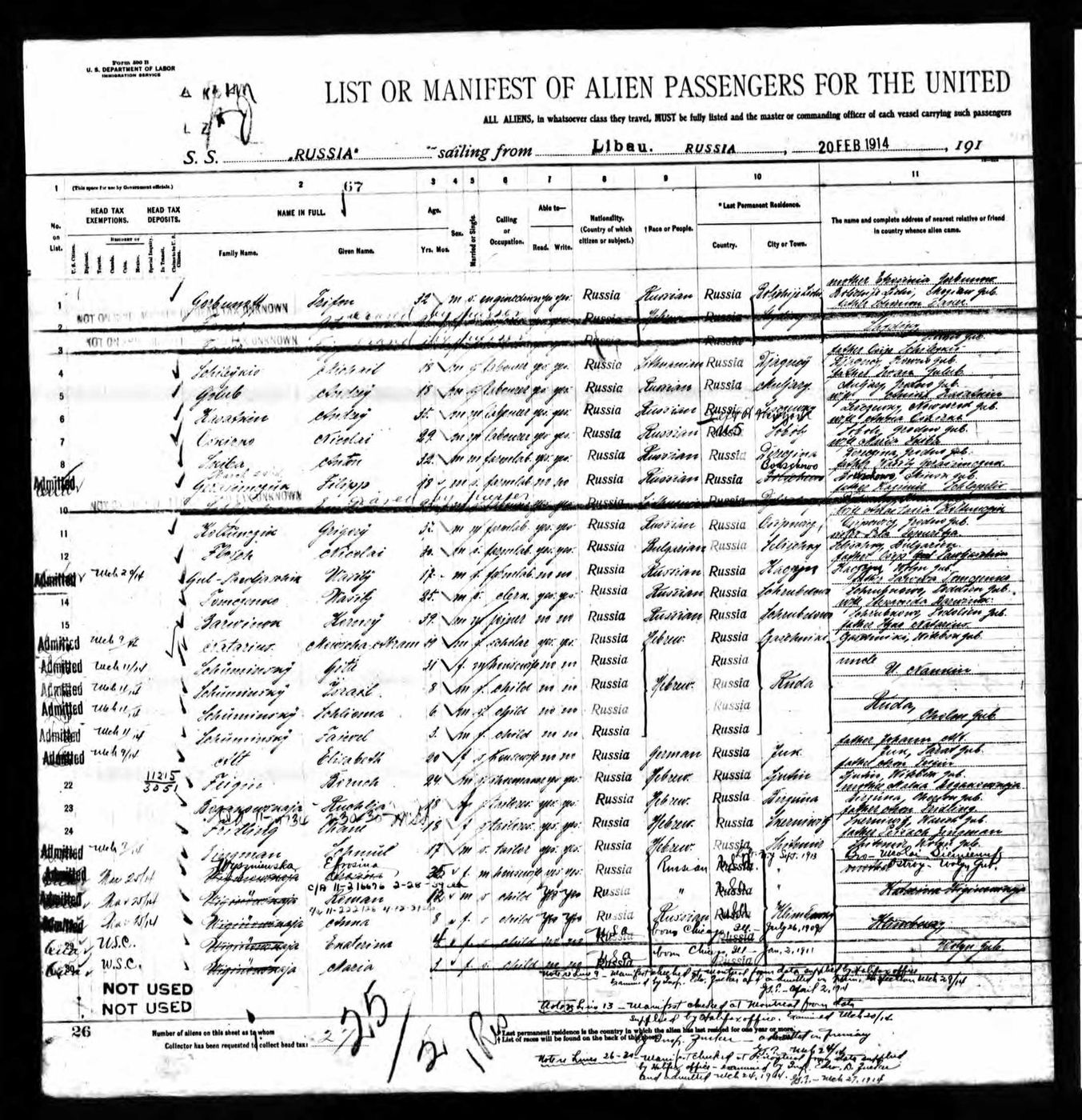
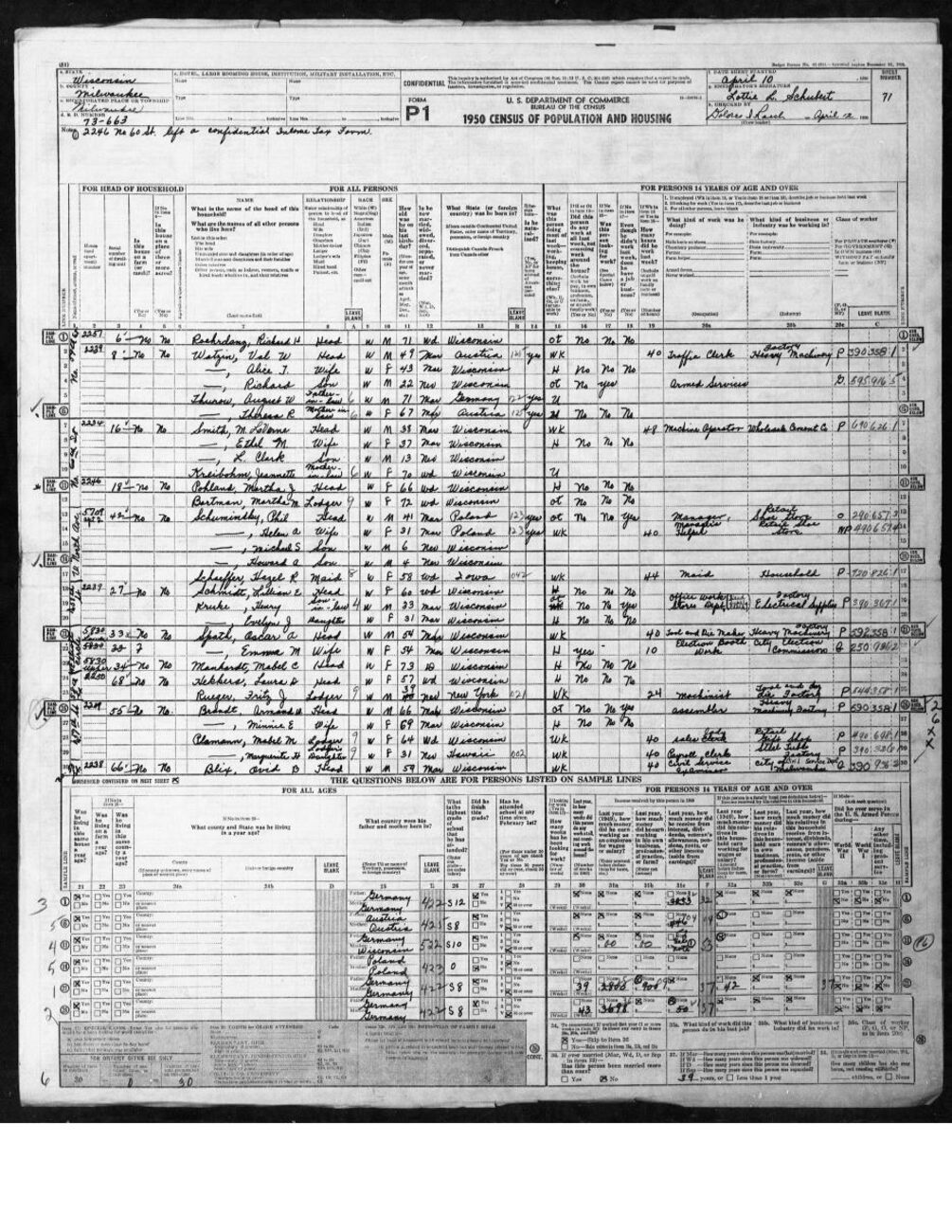
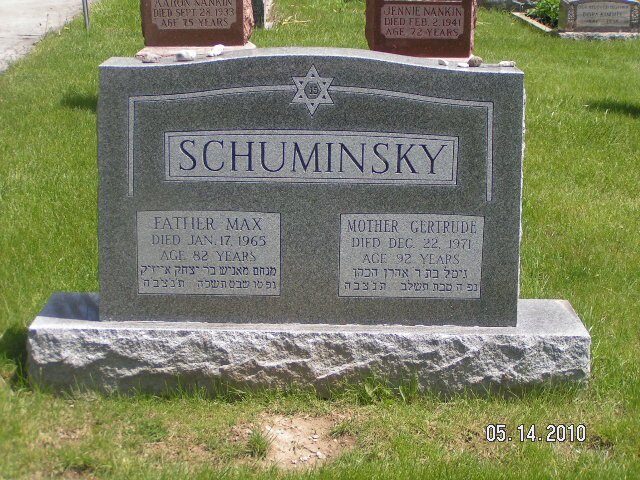
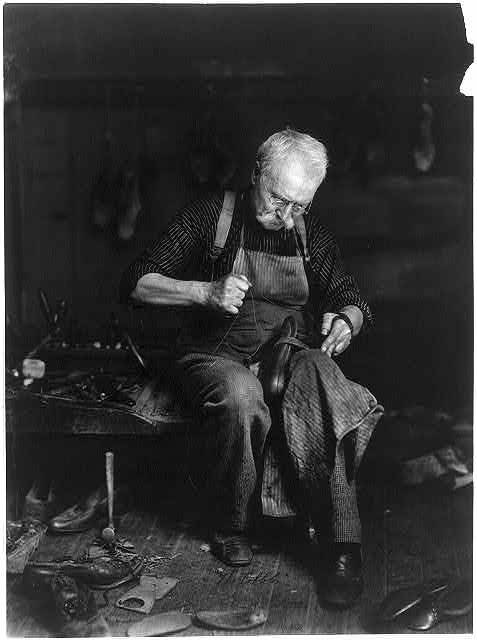
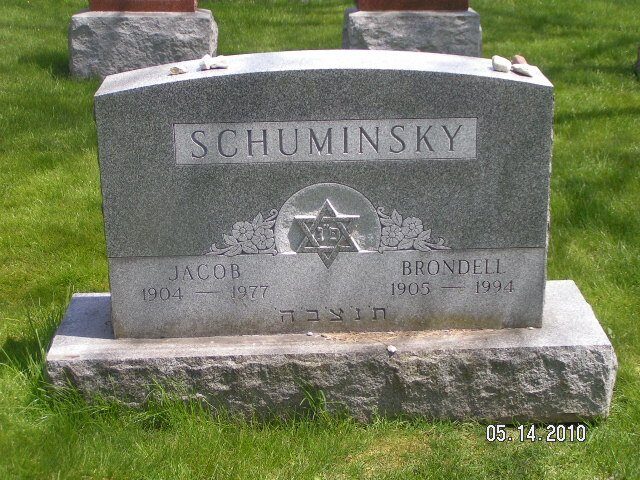
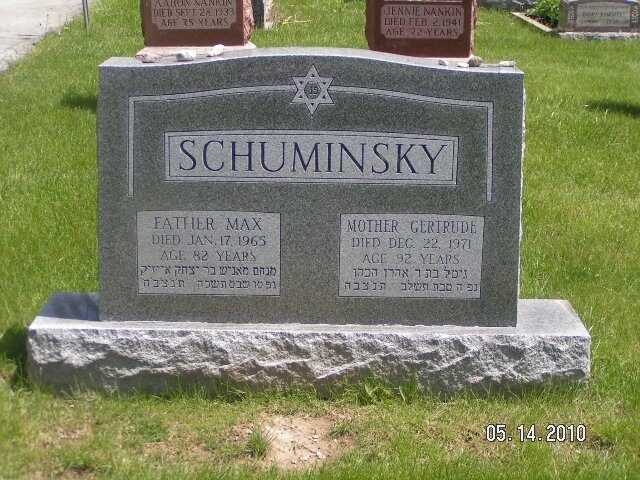
Narrowed again, 2026. Jack (b. 1904) crossed separately (S.S. Rochambeau, November 1914), so the three boys on the St. Albans sheet — read verbatim from the scan: Izrail 8, Schlioma 6, Faiwel 3 — don’t include him. Izrail is Sam to the day (born 10 March 1906, admitted 11 March 1914). The open fork: either Schlioma (b.~1908) is Phillip and Faiwel is the lost fourth son — or Faiwel is Phillip (Feivel→Phillip is the classic Yiddish–American pairing) and Schlioma is the boy who was lost. The Army’s enlistment file locks Phillip’s birth year at 1909, and border clerks understated children’s ages far more often than they overstated them — which tilts the reading toward Faiwel = Phillip, and Schlioma, b.~1907–08, as the boy the family lost. The family appears in no indexed 1920 census at all — and a 2026 line-by-line read of enumeration districts 277, 289 (the Muskego frontage) and all 39 pages of 290 found the street but never the family — house 1010 falls in a gap between the enumerators’ walking routes, which is why a century of indexes missed them. EDs 277, 289 and 290 have now been read in full — the family is in none of them; the likeliest truth is that the January 1920 enumerator simply missed the household, as happened to non-English-speaking families. The Schlioma question now rests on the Milwaukee death record, 1914–22. The Jewish Museum Milwaukee’s Death & Burial Index has now been read in full rather than in part, and it holds five Schuminskys — Max, Gertrude, Jack, Brondell and Beverly — every one of them an adult. No child, at any spelling. That is a negative with an edge rather than a silence, and it has a cause: a boy who died between 1914 and 1922 was never going to be at Agudas Achim, whose first interment came in 1923. The search moves to Second Home and Beth Hamedrosh Hagodel, and to the Milwaukee death record itself. The address, at least, is beyond argument: Polk’s city directories for 1919 and 1922 both place the household at 1010 Muskego Avenue, the later one naming the shop outright — M. Schuminsky & Son, shoes, 1010–12 Muskego Ave, the son being Jack. The address is not in doubt. The enumerator is. One word on that page does not fit, and it is printed too clearly to wave away: the 1922 entry names Max’s wife as Rachel. Polk’s convention is plain from the neighbouring lines — the name in brackets is the wife — and the page image was pulled and read rather than trusted to the transcription. It stands against five records that say Gitl or Gertrude, among them her own headstone, so it does not overturn her. It might be a double name, Gitl Rochel, of which a headstone would carry only the first. It might be a canvasser writing down whatever he was told at the door. What it is not, yet, is answered — and the document that would answer it is the same petition named above, which had to list Max’s wife by name. One ten-dollar file now closes two questions instead of one.
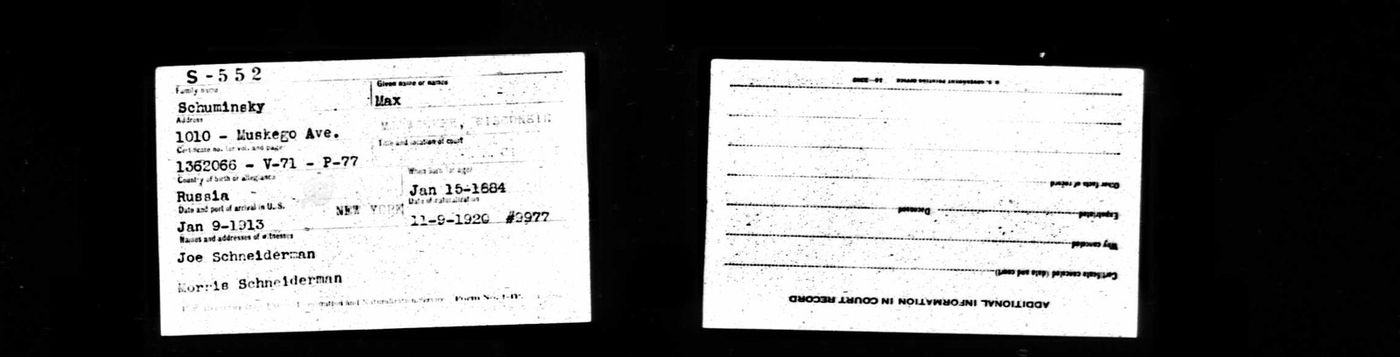
September 2026 — a third document, and a better one. Max's petition for naturalization has never been pulled. The 1906-era form required the petitioner to list his wife and every child, with each child's date and place of birth. Max was naturalized on 9 November 1920. So the petition is a sworn, dated enumeration of exactly which sons were alive that November, in his own account — which answers the fork directly instead of inferring it from a border clerk's ages. It sits at the National Archives at Chicago, Record Group 21, Eastern District of Wisconsin — unrestricted, not yet digitised there, and orderable for a ten-dollar flat fee.
The old index note "P-77 / V-71" also finally makes sense. It was assumed to belong to the microfilmed Soundex index, which has no concept of a volume at all — so it never resolved. Read against the court's own arrangement it is almost certainly Petition 77 in bound Volume 71 of Milwaukee's own petition series: a local shelf locator, not a national one. That sits comfortably beside certificate #1362066, because certificate numbers ran as a single national sequence across every naturalising court in the country while each court numbered its own books from one. A small local number and a large national one for the same November morning are not in conflict.
The census failure has a narrower explanation than a wrong-district theory, and the check that would have supported that theory refuted it. Running 1010 Muskego Avenue through the 1920 enumeration-district finder returns ED 277 as the address-correct district — one of the three already read line by line. So the family is not missing because we looked in the wrong place. What the same lookup did surface is ED 275, the adjacent district, which has never been read — its boundary runs 7th to 10th Avenue where 277 runs 10th to 11th, so it is a neighbour rather than a twin, and 277 remains the better geographic fit for a house numbered 1010. EDs 289 and 290 turn out to be neither anomalies nor candidates: both sit on the 15th Avenue stretch of Muskego, simply the wrong block. The next move is 275, and then a second, slower pass at 277 — not a theory.
3 · Where in Russia were the Finkels? Solved
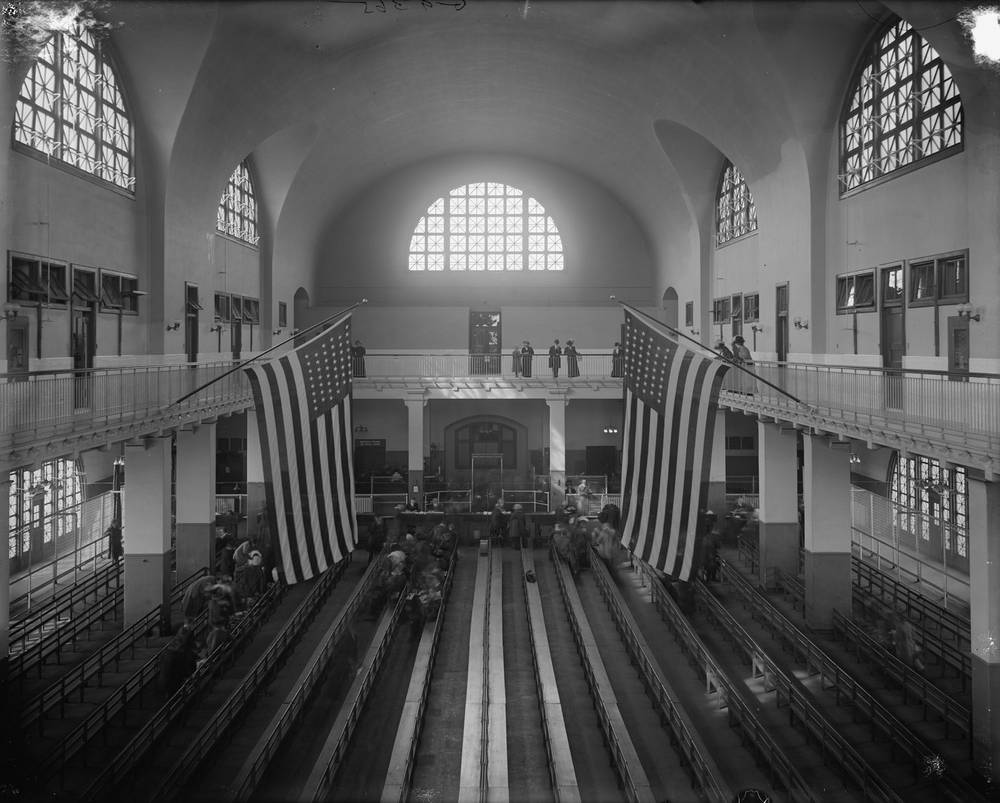
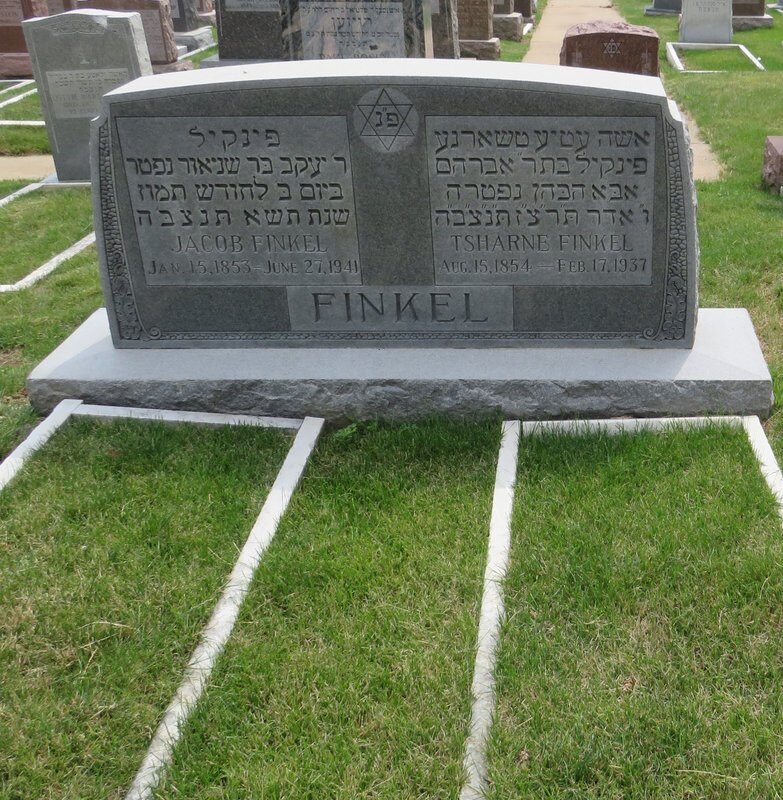
Jacob Finkel's hometown was recorded everywhere in the American record as just "Russia." It broke on his own 1902 Ellis Island manifest — column 10, in the clerk's hand: "Scharogrod," the standard German-clerk spelling of Sharhorod, a major Podolia shtetl (now Vinnytsia Oblast, Ukraine). The same document adds a fact the family record never had: Jacob's trade was cabinet maker. Still open, lower priority now: his 28 June 1941 Omaha World-Herald obituary, page 14, which may independently corroborate the town.
4 · Ruda Solved
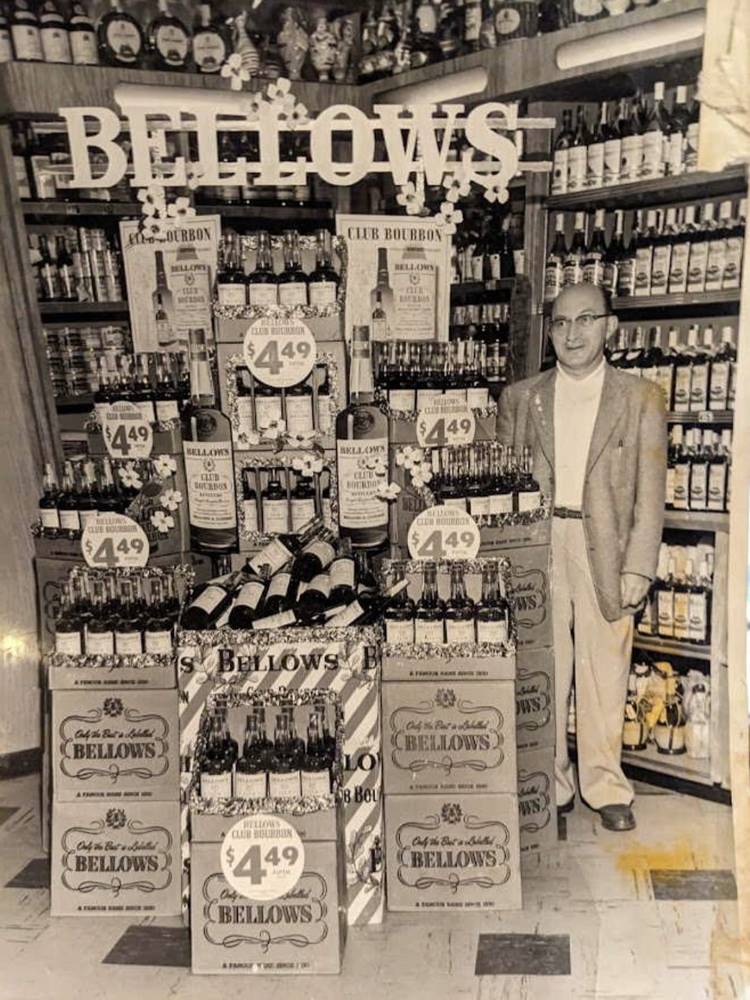
The family's last old-country address wasn't Włodawa town — the 1914 manifest reads Ruda, Chełm gubernia, now identified as gmina Ruda-Huta, about 30 km south of Włodawa. The Szumińskis had moved from town to countryside before they emigrated.
5 · The Chełm Nankins One act from proven
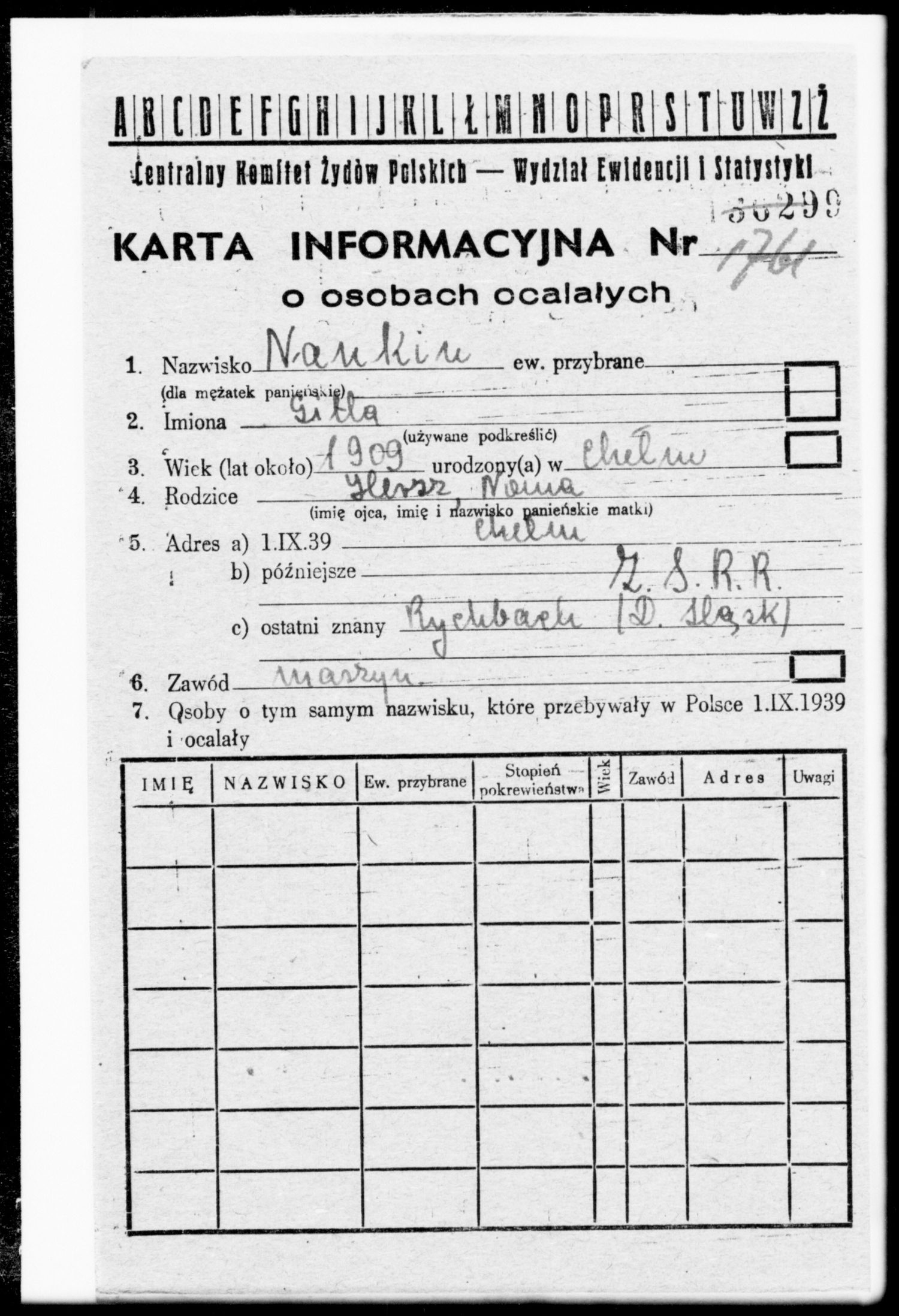
August 2026: a household of Chełm Nankins has been found alive in 1947 at Dzierżoniów, and the descent from Froim Fiszel now rests on four converging sources. The single document that would close it is Izrael Nankin's Chełm birth act of 15 April 1907. See And the Nankins who lived.
September 2026: found, downloaded, and read. Akt 203 of the Chełm register, entered on 15 October 1925 — eighteen years after the birth it records. The scan is free and public, and the hand is legible: "stawił się dziś Fajwel Fiszel Nankin, kramarz, sześćdziesiąt dwa lata liczący… i okazał nam dziecko płci męskiej, urodzone w Chełmie dnia piętnastego kwietnia tysiąc dziewięćset siódmego roku… z Chawy z Mandelbaumów." Fiszel Nankin, aged sixty-two, presenting a male child born in Chełm on 15 April 1907 to Chawa née Mandelbaum. It is the right act.
Two things in it were not in the index. The father's trade is given as kramarz — a shopkeeper — where the index called him a tailor; the tailors are the two witnesses, and the indexer collapsed the field. And one of those witnesses is Srul Sznajderman. Max Schuminsky's naturalization in Milwaukee was witnessed by Joe and Morris Schneiderman. That is very probably a coincidence — Sznajderman means tailor and is among the commonest Jewish surnames in Poland, and this man was one — but it is a coincidence with a test attached, and the test is whether the Milwaukee Schneidermans came from Chełm.
And the Milwaukee cemeteries answer a question nobody had put to them. The Jewish Museum Milwaukee’s burial index was read properly in September 2026 — the whole S range and the whole N — which corrected an earlier pass here that had reported a single unrelated Nankin. There are eleven. Three were born at Ruda-Huta, the hamlet outside Chełm the family left from: Albert Elya, 4 July 1894; Joseph, 1904; Ruth, 1904. And the index carries Hebrew patronymics. Aaron Urish Nankin — Gertrude’s father — is recorded as the son of Yisroel Yitzkok HaKohen. That is the same name this project already carries for the father of Froim Fiszel Nankin of Chełm, whose son’s birth act is transcribed above. If that is one man and not two, Gertrude’s father and the Chełm Fiszel were brothers, and the Milwaukee Nankins and the Chełm Nankins are one family split by an ocean rather than two families sharing a surname. It is a strong shape and it is not proof: a burial index transcribes a headstone, and Kohanic name-pairs repeat. The document that would settle it is Aaron Urish Nankin’s own birth or marriage act — one more reason to establish which registry district covered Ruda-Huta. That question now has an answer. A 1938 administrative return for gmina Świerże lists Ruda Huta among its localities and names a single Jewish registry district for the whole gmina — Świerże, not Chełm, and not the nearer town. The registry’s books survive and are digitised in full: 106 volumes, 3,437 images, with books open for 1858, 1894 and 1904 — the birth years of Gertrude’s father and of the three Nankins the cemetery index places at Ruda-Huta. The caveat travels with it: the document that names the district is from 1938 and the births are sixty to eighty years earlier, and administrative boundaries moved. So the test was run the same day, and it came back negative — and then, hours later, a second document explained why. The 1894 Świerże birth register closes with its own certified alphabetical index — thirty-two acts, every surname legible, and not one of them is Nankin; the parallel duplicate copy records no birth at all on the fourth of July. That is a real negative from a complete index, not a failed search. It leaves two live readings and this page will not pretend otherwise. Either Ruda-Huta answered to a different registry in 1894 than it did in 1938, and Chełm’s books are where to look next — or the family did here exactly what it is already documented doing in Chełm, where Izrael’s 1907 birth was not written down until 1925. Late registration is this family’s signature. A birth of 1894 may be sitting in a book of 1910, or 1925, under a clerk’s hand that never met the child.
Then the marriage registers were searched, which nobody had thought to do. Every previous pass through the Polish indexes had asked for births. Asking instead for marriages returned two Nankin entries at Chełm, and the second one is the best document this family has produced in Europe. Chełm, 9 July 1934, act thirty. The bride is Rajzla Nankin, a spinster of forty, and the clerk writes her out in full: «urodzoną w osadzie Sawinie, zamieszkałą w mieście Chełmie, córką Urysza i Geli z Sztajnbergów, małżonków Nankin» — born in the settlement of Sawin, living in Chełm, daughter of Urysz and Gela née Sztajnberg, spouses Nankin. Those are Gertrude’s parents. Aaron Urish Nankin and Gella Jennie, who died in Milwaukee in 1933 and 1941 and who until now existed only in American records — a headstone, a cemetery index, a death notice. Here they are in a Polish register, under their own names, in their own country.
It carries two things this page has to report rather than tidy. The first is Sawin. The family has been looked for at Ruda-Huta and at Chełm; nobody has looked at Sawin, which had a Jewish registry district of its own and which now turns up twice — here, and in a Milwaukee burial entry for another Nankin born there in 1900. The Świerże miss may simply be the wrong book. The second is harder. The register gives Gela’s maiden name as Sztajnberg. This project has been carrying Handelman, reconciled years ago from two American sources. A Polish civil register outranks them both on evidence, and one act does not outrank a decision made with the family’s own knowledge. So it is written here as what it is: unresolved, with the primary document on one side and the family on the other, and the next birth act the thing that would settle it.
September 2026 — resolved, at the family’s own call. A second document closes it. The same Chełm registry carries a 1930 marriage, act 76, in the same extended Nankin household, for a bride also entered as née Sztejnberg — an independent corroboration that a year of American tax and cemetery records never produced for Handelman. That older reading traces to a Jewish Museum Milwaukee burial-index entry for a Fanny Lieberman Handelsman Nankin — a woman born in 1900, thirty-one years after Gella, reconciled years ago against the wrong Nankin. Sztajnberg is adopted as Gella’s documented maiden name; Handelman stands corrected on the record, not erased.
Superseded, kept on the record: JRI-Poland's public legacy search returns it — Nankin, "Azryel," born 15 April 1907 at Chełm, father Fajwel Fiszel, mother Chawa Mandelbaum, akt 203. The birth date matches to the day, both parents match, and "Azryel" is the index form of Izrael already seen elsewhere in this family's records. What it also shows is that the act's registration year is 1925, not 1907 — a birth recorded eighteen years after the event, which was common. So the physical act sits in Chełm's 1925 birth register, not the 1906–09 book this page named a few hours earlier. That correction is the reason the index was worth searching before ordering anything.
The same search returned thirty-four Nankin births at Chełm, and inside them a recurring couple — Fiszel Nankin and Chawa Mandelbaum — with children indexed from 1885 to 1907: Cypojra, Sura Rywka, Srul Icek, Sura Itta, Mechel, Ruchla, Gersz Dawid. A household, not a name. The act will be in Russian; Congress Poland kept its registers in Russian from 1868.
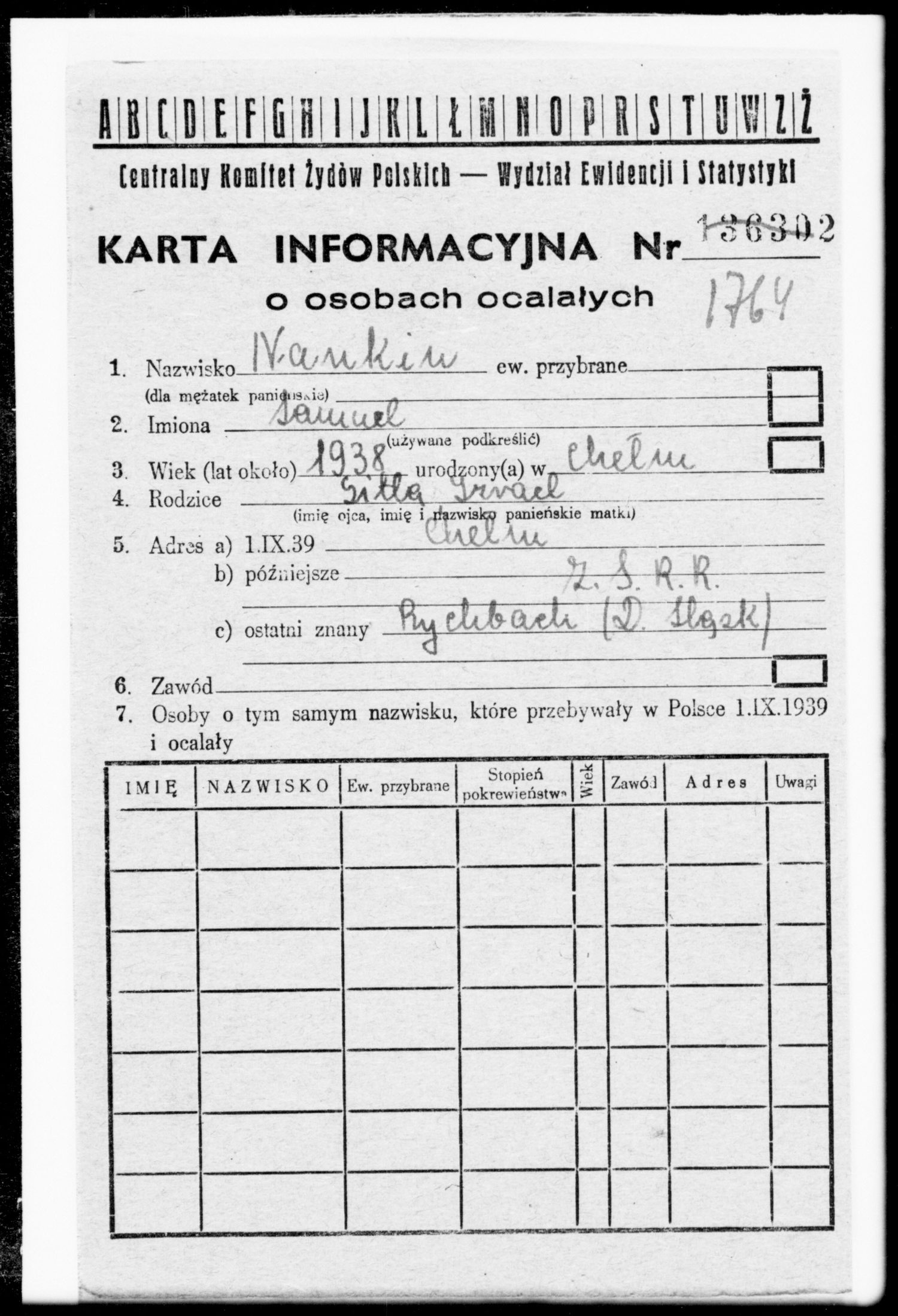
A Nankin survivor family from Chełm reached the records — Izrael (b.1907), Gitla, and their children, plus Chuna (b.1897). Their parents (Fiszel, Hersz, Lejwa) don't match Gertrude's father Aaron Urish — so not her siblings directly. The test set was: did Aaron Urish have a brother named Lejwa or Fiszel? A 2026 family descendancy chart answers half of it — yes, a brother Fishel Nankin (b.~1860, Chełm) is confirmed, with his own line running partly to Mexico City. Whether the Chełm survivor family descends from this specific Fishel, rather than a same-named cousin, is still the open piece.
6 · The shoe store's name Found
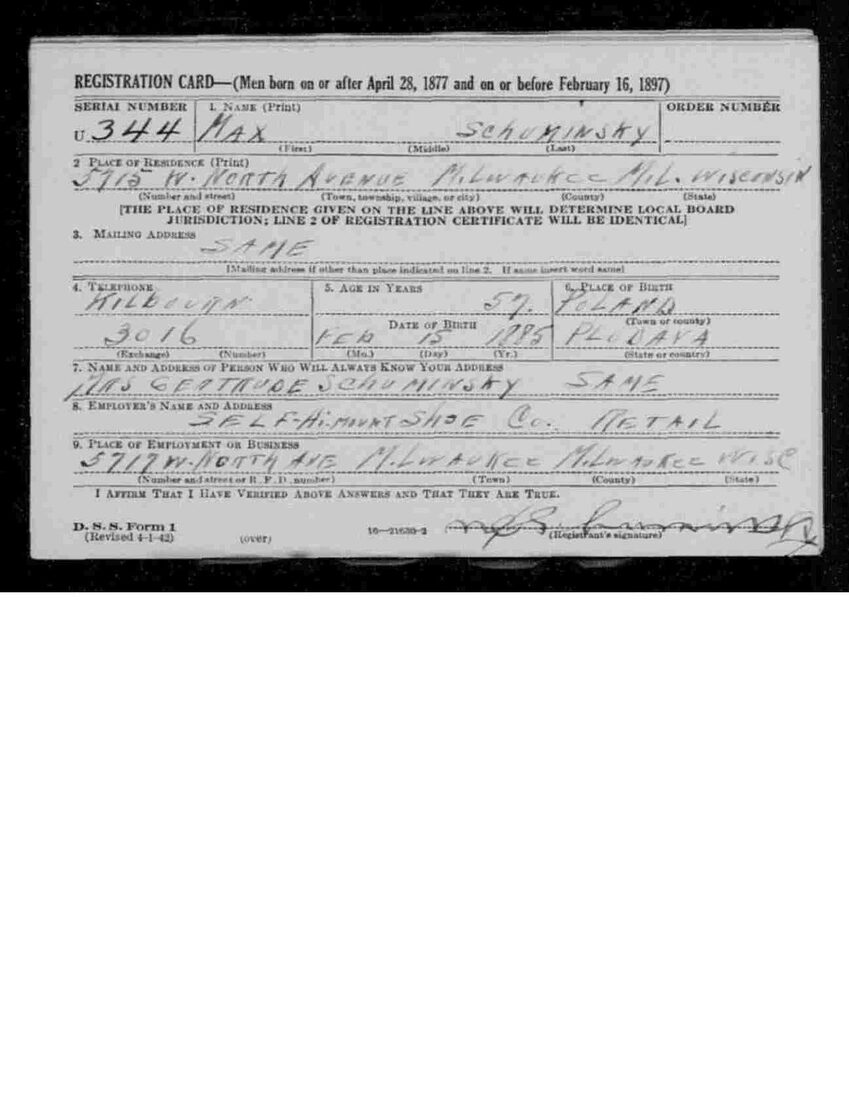
Resolved from a primary source: Max's 1942 draft card names his business Hi-Mount Shoe Co. (self-employed, retail), at 5717 W. North Avenue — the same address on Phillip's own 1940 card. The city directories add the earlier chain: shoe repairer at 967 Grant St. by 1915, then Muskego Avenue through the 1920s. "1369 8th Avenue," the address family memory has long carried, doesn't appear in any directory checked 1915–1927 — real to the family, just not yet placed in the record.